Why I'm Building ButterStack: I've Seen This Problem From Every Side of the Stack
Over 20+ years in games tech I've built engines and tools, repped them in the field, and run AWS's game-tech partner practice. Every seat showed me the same gap: studios can't see or operate their own pipelines. That's why I'm building ButterStack.

- About
- Game Dev
- Pipeline
Hey 👋, I’m Kevin.
I’ve spent more than twenty years in and around games technology: building the tools studios use, representing those tools in the field, and helping the world’s biggest cloud get into the hands of game developers. I’ve sat on almost every side of the game-dev stack, and from every seat I kept seeing the same problem.
A Career Spent Inside the Pipeline
I started at IGT (International Game Technology), where I spent over twelve years building video-slot games on embedded systems, then building the engines and tools the studio ran on as a Principal Engineer, and eventually managing the technical artist team that shipped 50+ games a year. When you’re responsible for the tooling behind that kind of output, you learn fast that the bottleneck is almost never the creative work. It’s the pipeline: the builds, the assets, the hand-offs, the “who changed what and why.”
From there I went to Unity Technologies as a Lead Field Engineer, embedded with studios from first inquiry through adoption, helping them build great games and navigate the organizational change that new tooling demands.
Then I spent five years at Amazon Game Tech, first as a Solutions Architect and Technical Evangelist for Lumberyard and GameLift, then running partner programs as a Senior Partner Solutions Architect and Partner Marketing Manager through the AWS Partner Network. That’s the exact rail ButterStack is building on today. I never stepped away from the possibilities AWS and other cloud providers have unlocked for developers. I even wrote, years ago, about centralizing game production assets on AWS with Perforce Helix Core, the same Perforce-on-cloud problem ButterStack now solves end-to-end. I was early to a thesis I’m now building a company around.
More recently I led Solutions Architecture at Forte and Pragma (backend platforms for game studios), and in 2024 founded ChiefTechAdvisor, handling the business and technology side for tech founders and creators.
The Gap I Kept Seeing
Engine vendor, cloud partner, consultant: the seat changed, the problem didn’t. Studios are brilliant at making games and consistently underserved when it comes to operating the production pipeline behind them.
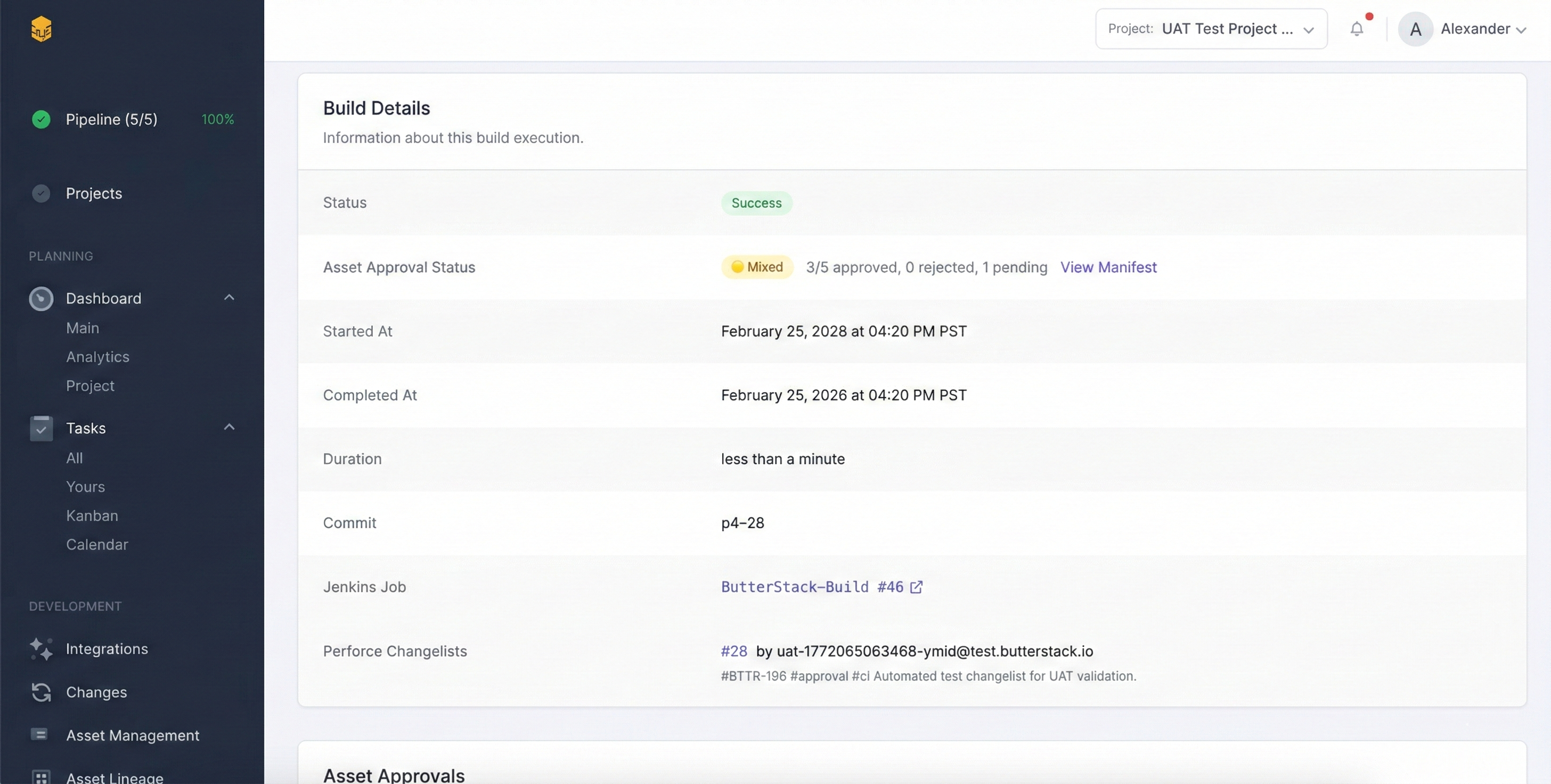
The big studios can paper over it by hiring internal tools teams. Everyone else (the 10-to-50-person studios doing remarkable work) is duct-taping Perforce, Jenkins, Jira, Steam, and an engine together by hand, with no unified view of any of it. I watched studio after studio reinvent the same integrations, fight the same build fires, and fly blind on the same questions: Who broke the build? Where’s this asset in the approval flow? Is our pipeline actually healthy?
I believe the magic happens where business and technology intersect, and that’s been the throughline of my whole career in Solutions Architecture. ButterStack lives exactly there: turning the messy, invisible operational layer of game development into something a studio can finally see, run, and trust.
Where I Come In
I’m Co-Founder and President of ButterStack. Ryan built Perforce’s cloud product and knows the source-of-truth side cold. My side is the rest of the stack and the business around it: partnerships with AWS and Perforce, game engine integrations, go-to-market, pricing, and the corporate foundation. Between us we’ve worked both ends of the exact pipeline ButterStack unifies, and I’ve spent my career on the partner and solutions-architecture rails we’re now using to bring it to studios.
I have a BS in Computer Systems Engineering Technology from the Oregon Institute of Technology. I later earned my MBA at the University of Nevada, Reno while I was a Principal Engineer at IGT. I already had the tech. I wanted the business knowledge to go with it. I’m also a named inventor on three patents, including one for testing and delivery of game design assets in a service-provider environment, which, looking back, was ButterStack-shaped long before ButterStack existed.
Let’s Connect
I love talking about game-development pipelines, partner ecosystems, and how studios actually buy and adopt tools. If you’re wrestling with pipeline visibility, Perforce-on-cloud, or scaling a studio’s operations, I’d genuinely like to hear about it.
Thanks!
Kevin Ashman
President of ButterStack
Want to see what pipeline observability looks like? Try ButterStack free and connect your first integration in minutes.
Or just email me at: kevin@butterstack.com.