Butter Up! Devlog #2: From Micro-Game to Vertical Slice in a Morning
Day 2 of building Butter Up! inside ButterStack itself. In one morning Pat O'Butter got a designed level, compound-butter flavors, a real save system, a body that visibly melts, checkpoints, and a win screen: every feature a real Perforce changelist.

- Game Dev
- Pipeline
- Perforce
- Automation
This is Part 8 of the “Agentic Game Dev” series. Part 1: The Manifesto → Part 2: The Framework → Part 3: Asset Validation → Part 4: Build Failure Investigation → Part 5: Pipeline Insights → Part 6: Dogfooding Our Perforce Agent → Part 7: Butter Up! Devlog #1 → Part 8: Butter Up! Devlog #2.
In Day 1 we introduced Butter Up!, a tiny precision platformer we’re building inside ButterStack to dogfood the real game-dev pipeline. By the end of Day 1, Pat O’Butter could walk, jump, melt, and reach the fridge. It was a complete loop, but a bare one: a single melt meter on an almost-empty plane.
Day 2 is where it started to feel like a game.
In one morning (built the same way, by AI agents committing real changelists into a real Perforce depot), Butter Up! picked up a designed level, compound-butter flavors, a save system that persists your progress, a hero who visibly softens as he melts, checkpoints, and a proper win screen. Here’s what landed, and why every piece of it is really a story about the pipeline underneath.
Day 2 walkthrough video to be added: Pat runs a real kitchen, a designed route, heat to time, a Mint station, checkpoints, and Pat flattening into a puddle as the meter drains.
What we built on Day 2
A designed level: “Parker House.” Day 1’s “level” was a flat test plane. Day 2 has an actual hand-designed route: a dozen platforms with jumps tuned to Pat’s exact jump arc, three heat zones to time (a warm strip, a risky burner, an “oven mouth”), cool pickups on and off the optimal line, and a continuous catch-floor so a blown jump never drops you off-camera. It’s pitched to finish with roughly half your butter left: survivable if you read the heat, punishing if you dawdle.
Compound-butter flavors. Pat can now pick up flavors at a station (Plain, Rosemary, Chili, Mint), and each one changes how he plays by re-tuning his movement and how fast he melts. In Parker House, a Mint station sits just off the main line as a safety net: melting out? Grab Mint, melt slower, limp to the fridge. No flavor is required. It’s optional depth, the way good platformers layer skill.
A save system: the ButterStack grows. This is the namesake mechanic finally made real. Win a level and you bank a pat onto a growing ButterStack; the game tracks your stack height, your best butter-score, and a small reserve of lives, and it writes all of it to disk. Close the game, reopen it, your stack is still there. It’s a genuine save system, not a fixture.
Pat visibly melts. Until now the melt meter was just a number. Now Pat’s body shows it: as the meter drains he squashes (flattening down, spreading out, sinking toward the floor), and his color shifts from solid butter-yellow to a pale, glossy, half-melted sheen. It reads instantly, no glance at the UI required.
Checkpoints. A longer level needs mercy. Checkpoints now update where Pat respawns, placed as rewards just past each hazard: clear the oven, and a melt-out drops you back at the oven’s far side, not the start.
A win that feels like a win. Reach the fridge and a big “YOU MADE IT!” banner reports your butter saved and your pats stacked; cross a stacking milestone and a “+1 STICK!” toast pops. Small touches, but they’re the difference between a tech demo and something you want to play again.
Every feature is a changelist
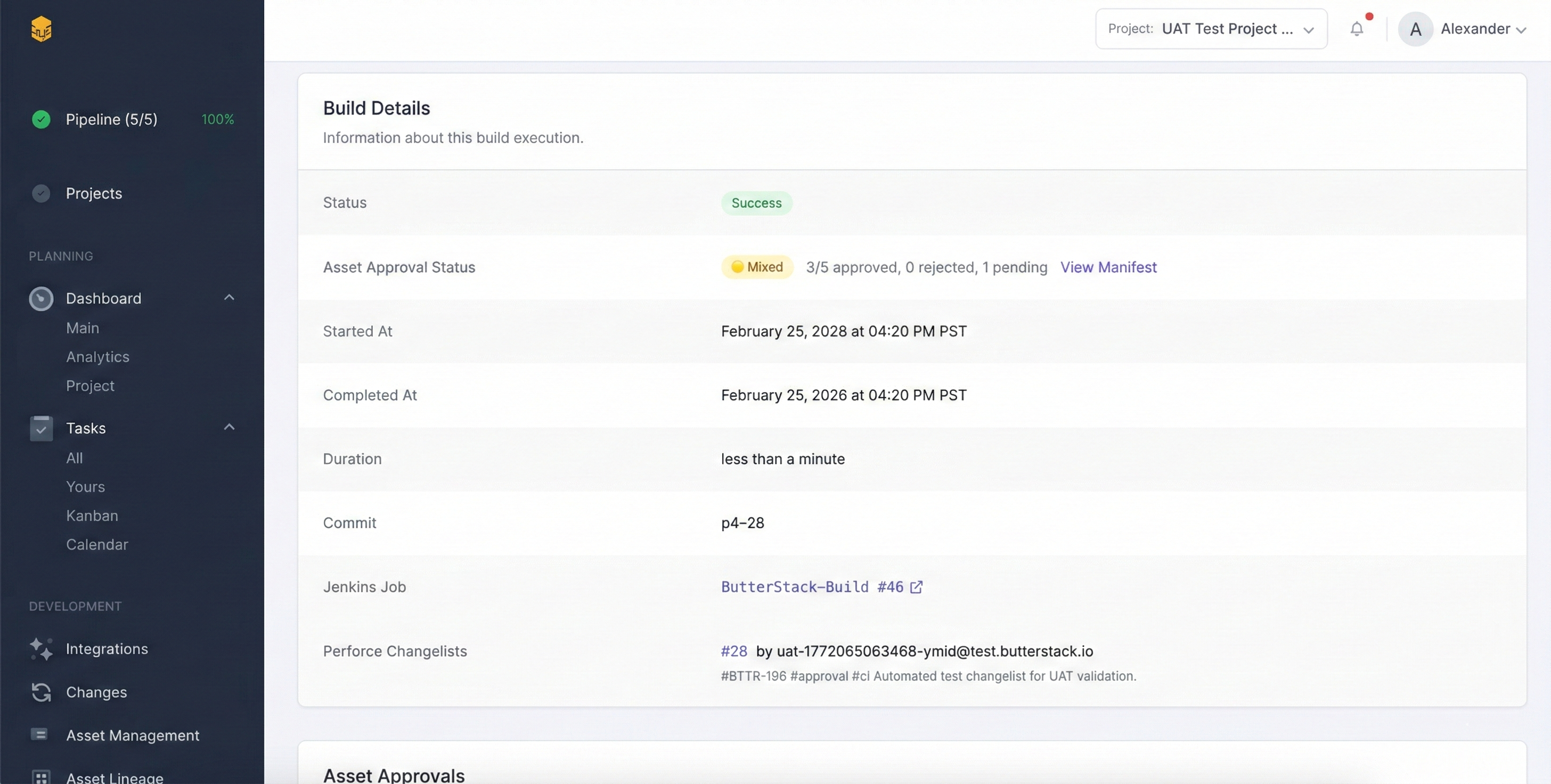
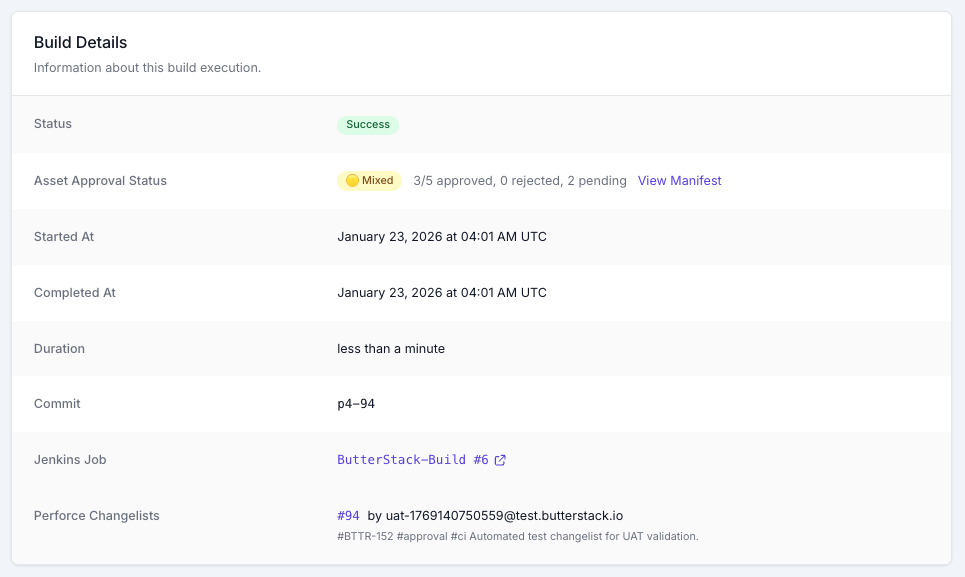
Here’s the part that matters for ButterStack. None of this was a mockup. Each feature above is a real, separate changelist in our Perforce depot: the level, the flavors, the save system, the melt material, the checkpoints, the win screen all landed as distinct, reviewable commits, one after another, on top of Day 1’s work.
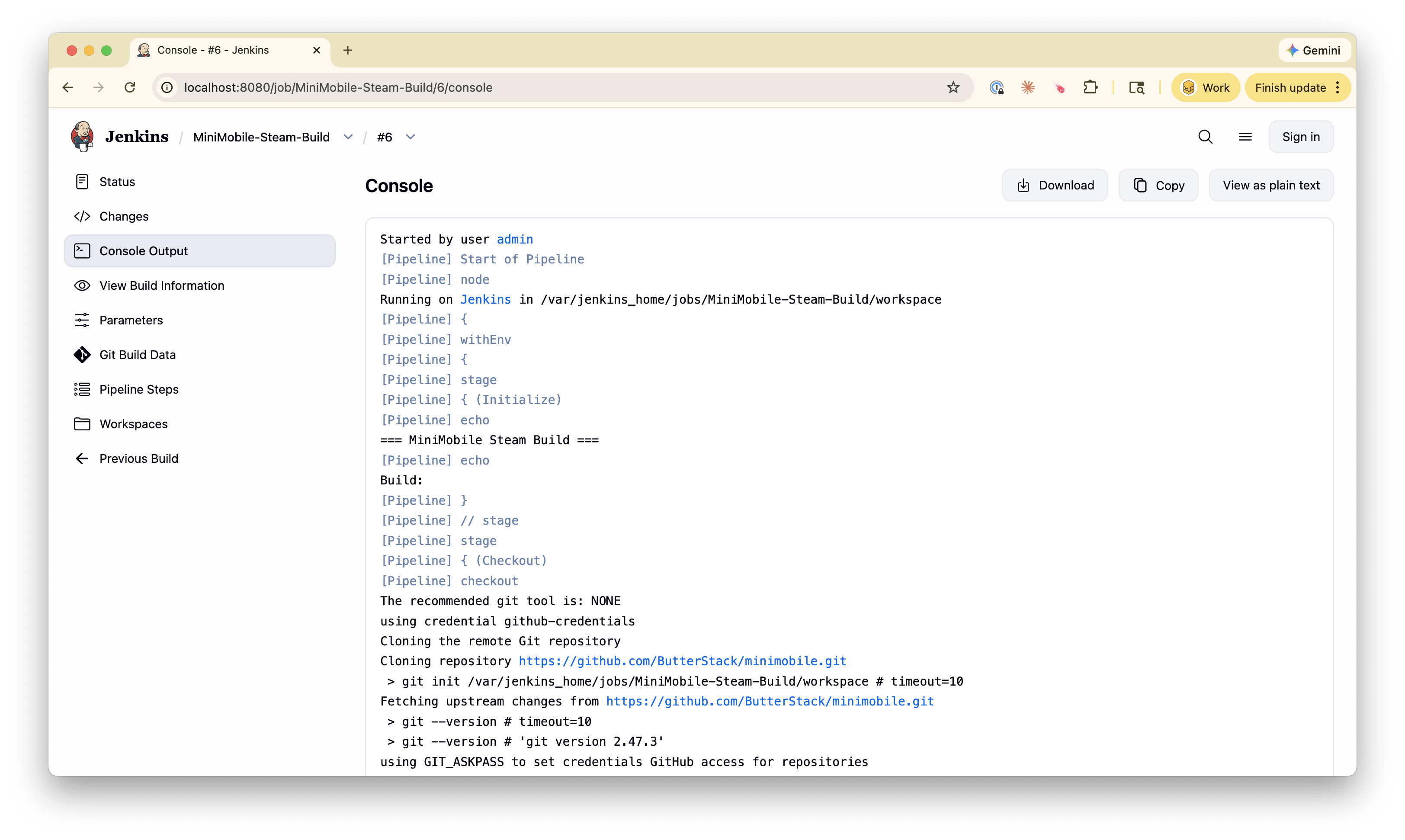
That’s exactly the artifact a technical buyer asks to see. Not “trust us, it works,” but an honest commit history where every capability traces to the change that introduced it, the binary assets (Unreal’s .umap levels and .uasset materials) moving through Perforce with their locks and lineage intact. When the demo is a real depot, “show me how this feature got built” has a real answer.
AI agents, with job titles
Day 2 leaned harder into something we think previews how studios will work. The morning’s build wasn’t one AI doing everything. It was a small team of agents with roles. A Game Designer agent authored the level layout in exact coordinates and made the call on which flavor belongs where. A Technical Director agent wrote the gameplay code, the save system, and the melt logic. A coordinating loop mirrored, compiled, packaged, and committed each result.
Every one of those commits is attributed to an AI author in the depot, right alongside where a human would be. That’s not a gimmick to us. It’s the near future of game development, and it’s precisely the future ButterStack exists to make legible: when agents commit alongside humans, you need to observe, attribute, and audit that work. We’d rather live that on our own project before we ask a customer to.
Honest about the state
We’ll keep being straight about where it is. The art is still placeholder: grey boxes and Canvas text. The numbers (jump distances, melt rates, the level’s difficulty) are first-pass and will want a real play-and-tune session. And it’s still a single level. This is a vertical slice, not a shipping game.
But it’s a real vertical slice (move, manage your melt, pick a flavor, hit your checkpoints, stack your win, and watch your progress persist), and it grew one authentic changelist at a time, on the exact pipeline we sell.
What’s next
Real art is the obvious next leap: an actual 3D Pat with a melt material that droops, a kitchen that looks like a kitchen. Beyond that: more levels that lean on checkpoints and flavors, a proper title-and-results flow, and wiring the whole thing through CI so a commit kicks a build automatically: the last mile of the “game studio in a box.” We’ll keep posting as the kitchen heats up.
Building a game and tired of stitching Perforce, Jenkins, and Jira together by hand? See what ButterStack can do for your studio. Free to start.